
Yamhill Scheduled Versus Actual Release
A scheduled or projected release date is a forward-looking estimate. An actual release date records an event that already occurred. Yamhill County’s Current Roster can display a Scheduled Release value for an adult in custody, but that field does not show that jail staff completed the release. Another hold, a sentence correction, a new court order, transport, or a data change can prevent the planned outcome.
A pretrial detainee often has no sentence-based release date. The person may leave after posting security, receiving a conditional release order, a dismissal, or another court action, but jail staff must also clear all other holds. A sentenced inmate has an ordered term, yet the responsible jail or ODOC must calculate credit, eligibility, and overlapping sentences. Only the releasing agency’s movement record confirms the final event.
Find Yamhill County Release Dates
The search route changes with the last custodian. Start at the source that owns the computation. County jail staff handle local physical custody. ODOC calculates state prison terms. BOPPPS sets projected parole dates only for older or special Board cases. A court judgment supplies the legal sentence but does not itself record when someone crossed the jail door.
- Identify YCCF, ODOC, FCI Sheridan, or another last custodian.
- Read the latest judgment for sentence length, jail credit, and concurrent or consecutive terms.
- For YCCF, record the Current Roster lookup time and any Scheduled Release value.
- For ODOC, check current Status, Location, and Caseload in OOS, but do not look for a date field that is not documented there.
- Request the sentence-computation or face-sheet record from the agency that calculates the term.
- Check holds, detainers, amended orders, parole action, and the intended destination.
- After release, obtain the actual movement or physical-release record.
The Yamhill County released-inmate search can help reconcile the later event with the court and receiving-agency record. Two-source confirmation matters. A scheduled value plus an actual jail or DOC movement entry is far stronger than either a roster disappearance or a single alert.
Yamhill Jail Scheduled Release
For an adult at Yamhill County Correctional Facility, begin at the official Corrections Division and its Current Roster. The roster can show Name, Book Date, Charge, Bail, and Scheduled Release. Detail records may add a file number and booking number, which are useful when speaking with YCCF Records. The county does not publish a separate historical projected-date tool.
A no-match does not settle the question. It can mean release, transfer, a spelling issue, or a roster change. Call the Release Office at 503-474-4985 or YCCF Records at 503-434-7507 extension 4490. Ask whether the person remains physically held, whether an actual event was processed, and whether the destination was the community or another custodian. For a durable answer, use NextRequest through Sheriff Records and identify the booking number, custody range, planned date, actual release time, release authority, and receiving agency.
Security payment also is not a date guarantee. Yamhill’s bail instructions warn that another county’s hold can remain. A court may authorize release on one case while another case or agency prevents departure. That is why the records request needs the destination and holds, not just a planned date.
Note: A Yamhill court order authorizes an outcome, while jail processing and hold checks determine when physical release can occur.
OOS Omits Projected Release Dates
The public Oregon Offender Search does not document a projected, tentative, or expected release-date field. Its search fields are First, Middle, Last, and SID Number. A detail record can show an ODOC photo, SID, court name, aliases, birth month and year, Location, Status, Caseload, current-cycle offenses, and an update time. Those fields help identify present custody or supervision. They do not supply a public date calculation.
OOS also is not a permanent archive of discharged people. Official help limits it to people currently in ODOC custody or under current local Community Corrections supervision. Someone may remain visible after prison release while on post-prison supervision, but a fully discharged former offender may disappear. A no-result should lead to Former Offender Records or the Public Records Center, not a claim that the person was never held or has been released.
The ODOC Public Records Center can provide the computation evidence that OOS lacks. Ask for first and last face sheets, sentence computation, actual physical-release date, release authority and destination, PPS start and expiration, and final discharge. Former Offender Records/OISC is listed at 503-570-6919.
Oregon Earned-Time Release Rules
Oregon does not use a universal rule that every prisoner serves 85 percent. Under ORS 421.121, an eligible ODOC felony term for a crime committed on or after November 1, 1989 may be reduced by up to 20 percent for appropriate conduct and participation in adult basic skills development. The statute excludes several sentence groups. Eligibility also depends on the judgment.
Measure 11 sentences under ORS 137.700 generally require the entire listed mandatory minimum and bar reduction or temporary leave during that minimum. Limited qualifying departures can occur under ORS 137.712. ORS 137.750 makes the judgment’s eligibility language significant. Those rules show why sentence length alone cannot yield a sound release date.
- Earned time
- A possible reduction for an eligible term based on statutory rules and qualifying conduct or participation.
- Jail credit
- Time credited toward a sentence under the judgment and agency calculation.
- Concurrent
- Terms that run at the same time.
- Consecutive
- Terms that run one after another.
- Detainer
- A request or basis for another authority to take custody.
A credible estimate starts with the judgment, sentence start, custody credit, and whether terms overlap. It then accounts for earned-time changes, amended judgments, nonoperative time, detainers, and program release rules. ODOC owns the operational computation. A hand calculation is only a rough hypothesis.
Changes to Yamhill Release Dates
A future date can move in either direction. Some changes alter the amount of custody time. Others keep the date but change where the person goes. The distinction matters because transfer to another custodian is not community release.
| Factor | Possible effect | Best record |
|---|---|---|
| Earned-time award or loss | Changes an eligible ODOC computation within statutory limits. | Current sentence-computation face sheet |
| Amended judgment | Changes the legal term, credit, or relationship among sentences. | Latest court judgment and agency recalculation |
| Hold or detainer | May prevent community release or redirect the person to another custodian. | Jail movement record or latest supervision order |
| Board action | May affirm, defer, postpone, or change a date in a covered parole case. | Latest Board Action Form or order |
| Short-Term Transitional Leave | May permit eligible physical release before the calculated end date. | ODOC release-counselor or program record |
| Data correction | Changes a displayed schedule without proving any release event. | Updated source plus actual movement record |
ODOC’s victim-services FAQ says release counselors verify an operational projected date one to two weeks before release. It also describes Short-Term Transitional Leave periods of 30, 60, 90, or 120 days for eligible cases. Neither point creates a public OOS date field. Contact the responsible counselor or obtain the underlying record.
Board-Based Yamhill Release Dates
Most people sentenced under Oregon’s modern determinate system do not receive a Board hearing to set a prison release date. BOPPPS still sets post-prison supervision conditions. Older and special sentence groups may have a projected parole date that the Board sets, affirms, defers, or postpones. For those cases, the latest Board order is essential.
An Order of Supervision can separate Physical Release Date, parole release date, PPS expiration, active-supervision review date, and a tentative parole-discharge date. These dates serve different purposes. The sample form also explains that correcting a physical-release date may alter supervision expiration, while release to a detainer for 30 days or more may affect when PPS starts or ends.
For a covered Board case, request the latest Board Action Form, Order of Supervision, amendments, and final discharge through BOPPPS Records. A calendar entry shows that a hearing was scheduled. It does not prove the result or the physical release.
Note: Parole is a Board-controlled release status for limited sentence groups, while PPS commonly follows a modern determinate prison term.
Yamhill Earned-Time Statute Source
The official Oregon Legislature text for ORS chapter 421 contains the earned-time rules used in an eligible ODOC computation.
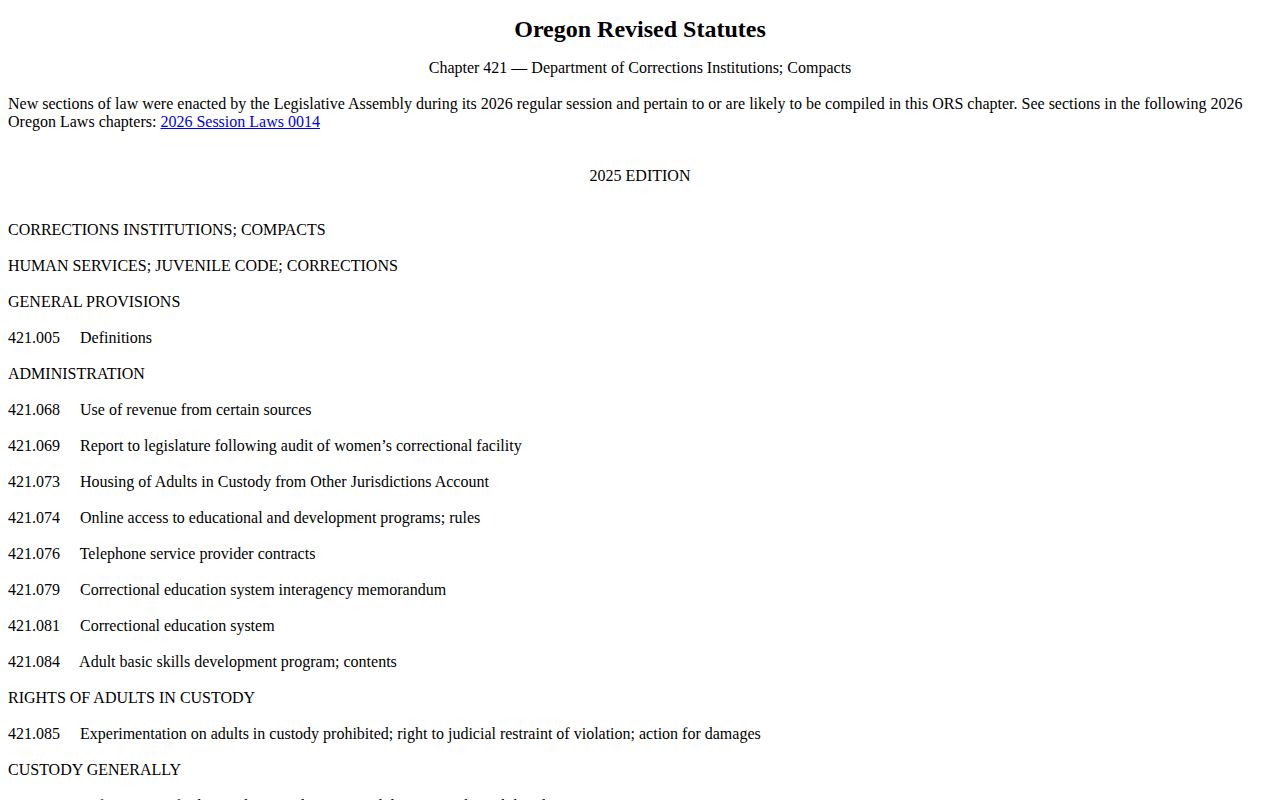
This statute supports the eligibility framework, while the person-specific face sheet remains the source for the calculated projected date.
Confirm Yamhill Projected Release
Near the planned date, check the system that owns the custody. For YCCF, contact the Release Office or Records unit. For an ODOC term, use the assigned release counselor and obtain the latest computation. For a Board case, read the most recent action. A Yamhill County VISOR notification can report a custody change, but the alert remains timing evidence rather than certified proof.
After the planned day, ask for the actual physical-release date, exact authority, and destination. If the person moved to ODOC, another county, BOP, USMS, or another agency, verify admission with that receiving custodian. If the record shows Community Corrections, distinguish release from physical custody from later discharge from supervision. These checks answer both when the person left and what legal control continued.
A retrieval date belongs with every projected value. That small detail preserves which version of the schedule was seen before a later recalculation, amended order, or agency update changed the answer.